
ART WITH A STORY | MILDRED FISCHER November 11 2026

Mildred Fischer, "MARDI GRAS" 1978 source: wallfiction.com
When Fibre, Paper and Art Become One
At Wall Fiction, we believe part of the pleasure of discovering art is discovering the story behind it.
Sometimes that story begins with an artist you already know. Other times, a work catches your attention first and sends you down a path of discovery.
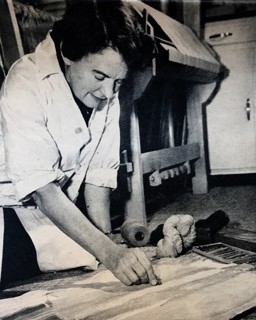
Mildred Fischer source: https://www.cincinnatiartmuseum.org/about/blog/library-blog-post-12142016/
Mildred Fischer is one of those artists.
A designer, educator, weaver and pioneering papermaker, Fischer spent much of her career exploring materials that had traditionally been associated with craft and asking a different question: Why couldn't they also be fine art?
The answer can be found in the remarkable works she left behind.

Mildred Fischer, "MARDI GRAS" 1978 source: wallfiction.com
From Weaving to Art
Long before fibre art occupied the place it does today, Fischer recognized the artistic possibilities of weaving.
Her education took her well beyond a traditional studio path. She studied psychology at Mount Holyoke College before pursuing design studies in Vienna and at the School of the Art Institute of Chicago. In 1940, she focused on weaving at Cranbrook Academy of Art in Michigan and later continued her studies in Finland and Norway.
Those experiences helped shape a sophisticated understanding of colour, pattern, texture and design that would follow her throughout her career.
Fischer eventually settled in Cincinnati, where she taught design, colour theory and art history at the University of Cincinnati's College of Design, Architecture and Art from 1955 to 1972.
But while she was teaching others, Fischer never stopped experimenting herself.
And eventually, that curiosity led her from woven fibre to paper.

Mildred Fischer, "RAIN FOREST" 1978 source: wallfiction.com
Discovering Paper
Fischer began experimenting with hand papermaking in the late 1950s.
For an artist already fascinated by fibre, it was a natural progression. Paper didn't have to be simply something on which an artist created an image. The fibres making up the paper could become the image themselves.
In 1969, Fischer took a sabbatical and travelled to Japan, where she spent three months studying traditional papermaking. Among her teachers was Abe Eishiro, the celebrated Japanese papermaker recognized for his mastery of traditional gampi paper.
The experience would have a profound influence on Fischer's work.
Returning to the United States, she began combining the two disciplines she knew so well: weaving and papermaking.
Threads, linen fibres, woven fragments and handmade pulp became her palette.
Instead of painting onto paper, Fischer was effectively creating paintings with paper.
Making the Material Part of the Art
Fischer's process was wonderfully physical.
She recycled linen fibres and remnants from earlier weaving projects, soaking and preparing the material before transforming it into pulp. She poured coloured pulp onto papermaking moulds, layering fibres and embedding threads and pieces of weaving directly into the wet sheets.
Some woven fragments were remnants from works she had rejected. Later, she began deliberately weaving small textile elements specifically to incorporate into her paper compositions.
There were no conventional brushstrokes.
The lines could be threads.
Colour could come from the fibres themselves.
Texture wasn't an illusion created on a flat surface. It was literally part of the artwork.
The result was something difficult to categorize neatly as weaving, painting, papermaking or sculpture.
Perhaps that was exactly the point.
1978: An Important Year
By the 1970s, Fischer had developed a distinctive visual language built around colour, abstraction, fibre and handmade paper.
In 1978, her papers and woven works were featured at Cincinnati's Contemporary Arts Center—an important recognition of a practice that deliberately crossed the traditional boundary between art and craft.
It was during this same year that Fischer created the work that ultimately found its way to Wall Fiction:
Mardi Gras, 1978

Mildred Fischer, "MARDI GRAS" 1978 source: wallfiction.com
The title couldn't be more appropriate.
Against a heavily textured handmade-paper ground, colourful woven fibres, threads and fragments move through the composition with an almost celebratory energy.
There is structure, but also spontaneity.
Order, but also movement.
Look at it from across a room and you see an abstract composition. Move closer and another artwork begins to reveal itself—the individual fibres, threads, layers and woven elements that physically make up the piece.
It is a work that rewards looking twice.
And then looking closer.
The other amazing one is:
Rainforest, 1978

Mildred Fischer, "RAIN FOREST" 1978 source: wallfiction.com
The title again couldn't be more appropriate.
Against a heavily textured handmade-paper ground, colourful woven fibres, threads and fragments move through the composition with an almost celebratory energy.
There is structure, but also again spontaneity.
It is another work that rewards looking twice.
And then looking closer.
An Artist Who Followed Curiosity
One of the things we find particularly compelling about Fischer is her willingness to keep learning.
She was already an accomplished artist and educator when she began seriously exploring papermaking. Rather than remaining within the medium for which she was already known, she travelled to Japan, studied another tradition and incorporated what she learned into a visual language that was distinctly her own.
She experimented constantly.
Materials that might otherwise have been discarded became the starting point for something new. Failed weaving fragments could become part of a successful paper work. Traditional processes could be respected without preventing experimentation.
That curiosity seems especially relevant today, when the distinctions between painting, sculpture, textile, fibre and mixed-media art have become increasingly fluid.
Fischer was exploring that territory decades ago.

Mildred Fischer, "MARDI GRAS" 1978 source: wallfiction.com
A Legacy in Fibre and Paper
Fischer continued to influence artists not only through her own work, but through decades of teaching and her willingness to share what she had learned.
Her works were exhibited at institutions including the Contemporary Arts Center in Cincinnati, the Cincinnati Art Museum, Yale University and London's Victoria and Albert Museum, and examples entered public and private collections.
Today, the Cincinnati Art Museum's Mary R. Schiff Library and Archives preserves Fischer's papers and archival material, helping ensure that researchers and future generations can continue exploring her contribution to twentieth-century fibre and paper art.
But perhaps her legacy is most tangible when standing in front of one of the works themselves.
The materials tell the story.
From Cincinnati to Toronto—and Now to Its Next Wall
Wall Fiction's Mardi Gras and Rainforest comes from a private Toronto collection.
Created in 1978, the work combines woven fibre on handmade paper, is signed and dated by Fischer, and retains information about its title and materials on the reverse.
More than four decades after Fischer combined those fibres, threads and handmade paper, Mardi Gras and Rainforest are ready for another chapter.
Discover the story. Collect what you love.